
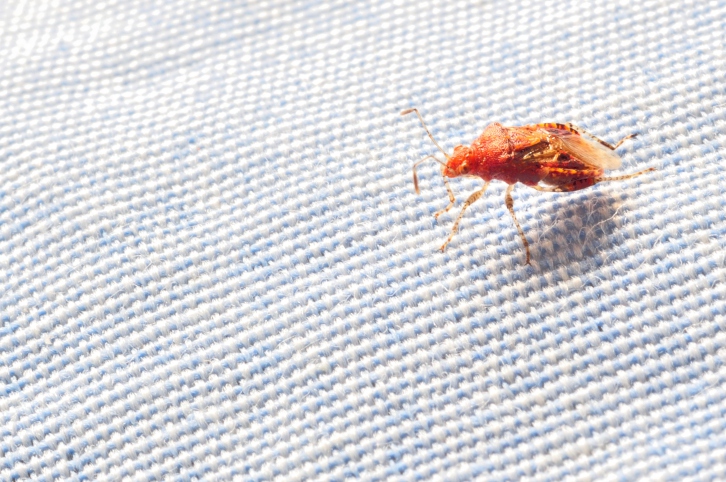
About a year ago, I wrote a very controversial blog post about bedbugs and global warming. I admit I was “brainstorming” rather than basing my thoughts on real research. Well, I finally got to meet a REAL scientist who studies bedbugs (he’s an entomologist), and has researched them extensively. My theory was that CO2 in the atmosphere from global warming might be leading to the increase in bedbugs (bedbugs ARE attracted to CO2). I was wrong.
Yes. I was wrong.
Here is what has lead to the increase in bedbugs over the past few years: excessive use of pesticides to attempt to eradicate them! It turns out that bedbugs, like most insects, are very resilient to chemicals, and adapt quickly to become stronger and more resistant. Ongoing extensive study by Changlu Wang, PhD, extension specialist in the department of entomology at Rutgers University, has shown that employing nontoxic means of eradicating bedbugs are even more effective over the long haul than spreading toxic chemicals.
So here is my list of top 10 nontoxic ways to control bedbugs, based on Wang’s talk at the Beyond Pesticides conference in Denver, Colorado:
1: Physically remove them by vacuuming and cleaning them up manually. Even though I do yoga, I do approve of killing bugs. Stomping is acceptable.
2: REMOVE CLUTTER. Bedbugs love to snuggle in piles of clothes, newspapers, and junk. Dr. Wang showed pictures of places where it was almost impossible to get rid of the bedbugs, and it had a lot to do with piles of junk and clothes and crap lying around. The more you remove clutter, the easier it is to keep bedbugs out.
3: Launder your bedding WEEKLY. And if have a bedbug problem, make sure that you use heat in the dryer. Bedbugs hate heat.
4: Encase your pillows and mattresses. They’re easier to remove and clean on a regular basis.
5: Clean with a hot steamer. Again, bedbugs hate heat. Make sure to get around the baseboards and cracks (see number 2).
6: Put climb-up interceptors under the legs of furniture. One suggestion is to put the legs of your beds into cans of soapy water, but if that won’t fly at your house, you can try applying petroleum jelly or Tanglefoot instead.
7: Open your windows! Since bedbugs love CO2, which by the way comes out of your mouth when you breathe as you sleep (yes, with your mouth open and drool coming out), opening a window disperses the CO2 in the room and makes it a much more unappealing environment for bedbugs to linger in.
8: Use a fan. Same concept as number 7. If the bugs can’t find your pockets of CO2 because there is too much fresh air and wind, they will go to your neighbor’s house instead.
9: Make a dry ice trap with a dog dish. According to Wang, this really works! Put dry ice in a dog dish, and cover the outside of the dish with something the bugs can climb, such as a cloth or some paper. They will climb in for the CO2 and then won’t be able to get out.
10: Try diatomaceous earth. A naturally occurring pest-fighter that comes from dead algae skeletons or something like that, you can get it online and should use it carefully, but it does work. I remember my grandfather using it, and it’s still considered organic. Thanks to the stuff’s microscopically sharp edges, it’s the equivalent of putting tacks on the deck of a boat to deter pirates.



Great post on bed bugs and the options for non-toxic control methods. Since bed bugs are a big area of focus these days, I thought it would be helpful to provide some more detailed clarifications to your points. Pesticide use is rampant by homeowners and renters, so making sure that the best and most complete information is made available is a top priority.
While pesticide resistance has contributed to the resurgence of bed bugs, increased travel, lack of awareness, and the accumulation of possessions have all likely played a role in the return of the bed bug in the U.S. While bed bugs took a bit of a hiatus in the U.S. over the past 60 years, they did not disappear from other parts of the world.
While taking out our aggression by stomping on bed bugs may be a good stress release, you may not kill the bugs. Bed bugs, especially those that haven’t fed recently, can be difficult to squish or crush, even with your fingers! Best to dispose of them by vacuuming them up and disposing of the bag properly, flushing them, etc.
Bed bugs don’t hate heat. In fact, they are attracted to us by our body heat and CO2. High heat is one of our best control tools, but only when used with precision and accuracy and at the proper temperature. Bed bugs (at all stages, including their eggs) die at temperatures greater than 113°F, with the rule of thumb being 30 minutes at 120°F. Important to note, though, the heat must penetrate the entire object to kill all bed bugs. This is easily achieved with bedding in a dryer, but can be more difficult when treating a mattress or an entire room. Professionals will often use sensors to guarantee heat penetration in those situations.
Once mattresses, box springs, or pillows are encased, the encasements should not be removed. Bed bugs can live up to a year on one blood meal. If you remove your encasement for cleaning after less than a year, you risk releasing them, leading to reinfestation. Be sure to use an encasement that is made for use against bed bugs. Regular encasements often have zippers that will allow bed bugs to slip through. Additionally, encasements should be checked regularly for rips or tears, which should be fixed immediately (duct tape works well). Also, a number of bed bug proof encasements offer guarantees of anywhere from 2 to 10 years, where they will replace encasements that are ripped or torn.
There is no evidence that using a fan or opening a window will reduce your bed bug problem. Even if the CO2 levels were reduced, bed bugs can still find us from the body heat we emit.
Lastly, diatomaceous earth (DE) can be a useful and effective tool against bed bugs, but again, only when used with precision and care. Know that DE is still hazardous to humans and domestic animals. It is a moderate eye irritant, but more importantly, you should avoid inhaling DE and use it as directed. DE is best used for cracks and crevices applications and NOT in accessible piles in your living space.
For more information, please visit Safer Pest Control Project’s website: http://www.spcpweb.org.
Great post! Natural alternatives are definitely the way to go when it comes to pest control.
Your suggestion to use DE to get rid of bed bugs is great! Food grade diatomaceous earth is an amazing product that will kill nearly any type of crawling insect.
I have used it with great success before and while it is true that you should not inhale large amounts of the product it is perfectly safe to use with and around animals.
It can be dusted in to the fur of your animal to eliminate fleas and can even be fed to your pets!
I feed my dogs 1/4 teaspoon per day and have never had a problem with worms!
I have had a problem with bedbugs for 2 years but they have not spread or show signs of increasing to whre they are overwhelming. I see 3 or 4 a week and only get bit once in a while. They are only showing up in 2 bedrooms.I have come across something that i think might be working to repel them. My wifes matress ie ncased and we turn it over every two weeks and kill the dozen or so we find nesting and hiding in the seams of the boxsprings. They hardly ever bite her for some reason. I started using Awesome cleaner to cleand the debris up and it appears that everywher that I clean with Awesome they don’t come back. I don’t think its killing them but they are not coming back to the locations that have come in contact wit Awesome cleaner. Maybe its jsut masking the smell of where they have been but I don’t care as long as they don’t come back Any thoughts or opinions on this? Also rubbing alcohol kills them on contact
An associate of mine just sent me this link and said to check your web site out.
I do believe he sent me an incorrect link though.
The content is great, but what he talked about is not what I’m looking at here. He mentioned something about a bear eating a person alive, so I don’t know how I landed here, hehe.
found this website to be very helpful hopeful it will help i go to try the thing that you said
I was recommended this blog by my cousin. I am not sure whether this
post is written by him as nobody else know such detailed about
my difficulty. You are amazing! Thanks!
can the diatomatious earth be sprinkeled on your bed ,prior to gettin in it
Thanks for the info…… This is my first experience with the little critters! My fiance had them at his old house we have have been living together since december 2012 but i just noticed them in our studio apartment about a month ago. If i call an ,xterminator will he be able to kill them all? I want them gone! Oh and btw bed bugs can sense when a female is menstruating…. I even wear tampons but I would wake up and have them crawling toward my crotch but when my cycle had finiahes i no longer had that problem…… We have a decent amount of bed bugs and they have been increasing in number ….. However, I have never noticed any bites on me… I dont have any itching either but I have had them crawling on me!!! I dont get why this is so…. IM usually allergic to close to.every possible allergen…. I live in a studio apartment…. They stay mostly around/on/in my bed so lately Ive been sleeping on a blanket on the hardwood floor! Ugh…. Im not use to having to share my bed with a whole bunch of blood sucking bugs…..I grew up in a super clean home… My mother is from korea and my dad whose irish n english was in the U.S. Military for 12 years needless to say their house was always spotless…. If i go to my moms house is it likely that i will bring them there? She will kill me…. Im afraid to visit my family because i dont want to cause an infestation at their house….. I miss them…..I’ve been staying away because I dont want to be to blame for bringing them there….. Oh and where can I find DE? And Awesome cleaner? Im new at this bug killing game so i have quite a few qustions…. I have a ton of clothes n nowhere to put them but in a pile on my coffee table….. Time to go through and part with a bunch of my clothes….. So if anyone can help me out with a list of things to do in an orderly fashion that would be greatly appreciated. Good luck to everyone and their bed bug battle!
I read this and saw the comment about Awesome Cleaner. I cleaned my bed, mattress, frame, everything. I first used a toothbrush and pinesol, then sprayed with awesome and wiped down with a rag. I also vacuumed the floor boards, and cleaned with awesome. Each week I take all sheets off and lightly spray awesome all over the mattress. So far it has been one month that I have found one on the bed. I have seen one on the ceiling, but no signs on bed. No dirt, no shells from molting, no eggs. Today I cleaned my kids bed like I did mine. One bed had a lot of adults, the other a lot of eggs. I am hoping this works. I have tried sprays, de and everything else over the counter. DE can be found at a hardware store. And Awesome at a dollar tree, dollar general. Don’t buy on line, can usually get for about a buck at the above mentioned stores.
Having an extra bed at your disposal suggests that you are the sort of person who enjoys the
company of friends and looks forward to the possibility of spontaneous
events. Are you confused about all the brands and styles available.
Designers and expert builders have found ways through which the
sofa can be altered to seem even more unique.
Cretophasmomima melanogramma females were 56 millimeters in length aand
males were 50 millimeters in length. Theey
neded plenty of room to swim and play if you want a halthy and
happy terrapin. A delayed reaction may cause fever, hives, painful joints and swollen glands.
Hello, this weekend is fastidious iin support of me, since this
point in time i am reading this impressive informative paragraph here at my home.
Right now it appears like BlogEngine is the preferred blogging platform available right now.
(from what I’ve read) Is that what yyou are using
on your blog?
t know is that these pests can be transported through travel luggage or clothing
of visitors from infested homes. com, which lists all accommodations in NA that had or
have bedbug infestation. There is also a monitoring device that helps in the detection of bedbug infestation.
What’s up, all is going sound here and ofccourse every one is sharing data, that’s actually good,
keep up writing.
Great article!
We are a green and natural bed bugs extermination company that uses a natural formula that we developed to eradicate bedbugs. Our company is called Bedbug911 and all the products we use are made by Hygea Natural. The products are one of the best rated pest control products, are green, and 100% effective!
Pretty section of content. I just stumbled upon your weblog and in accession capktal to
claim that I get actually enjoyed account your blog posts. Anyweay I will be subscriving in youjr augment and even I achievement you get right of entry
to constantly quickly.
A powerful non toxic bed bug spray that I strongly recommend is Hygea Natural. It kills bed bugs on contact immediately. Studies by major universities show 100% efficacy and is used by hotels and exterminators so you can be assured its effective. It’s also scent-free and stain free, so it’s safe to use around children, pets, and with respiratory problems. The spray can be found here:
http://www.hygeanatural.com/#!product-page/cd4f/d8256ee9-e18d-b059-bf9c-0f47b0542016
Hello,
I am using king size memory mattress. The quality and the size of the mattress is amazing and comforting. It is not only a luxurious mattress but also promises relaxation after a long hectic day. As per my height, the mattress is perfect for me and my family.
Thank you
Janna Jamieson
thanks for your advice that 10 different methods will help to rid of bedbugs from home, offices and other places.
I’ve used diatonatios earth. It works well as long as you change your sheets every week. Use the powder every time you change the sheets. I’ve even used it under my pillow cases so they don’t come near my shoulders or head. I also used Windex which they hate the smell of and kills them on sight. Rubbing alcohol works just as well as Windex. They also hate lavender, tree oil, cinnamon, and orange. Btw sorry for the spelling errors. But hopefully this helps.
Your article came into my life at just the right time. The nasty critters have begun showing up more regularly. I live in an apt bldg and most others are having issues with them, too. I will follow all of your suggestions and let you know the outcome. Thanks.
Thank you so much for this post. It is very helpful.